Earlier in this series
- Part 1: Investing Beyond Your Home Market, on why portfolios stay so close to home
- Part 2: Investing Beyond Your Home Market: Asia, on eight Asian markets and how to reach them
In the first part of this series, I wrote about home bias, and in the second part we put the idea to work in Asia. Latin America is the next stop, and it has already drawn attention. While much of the geopolitical news comes from the Middle East and Eastern Europe, five Latin American countries ranked among the world's ten best-performing equity markets in the three months to mid-January 2026, helped by metal prices and a weaker US dollar.
I live in Spain, where Latin America is never far away, so it feels closer to me than the regions we have covered so far. That feeling is exactly what Part 1 warned about: closeness to a market is not the same as knowing it.
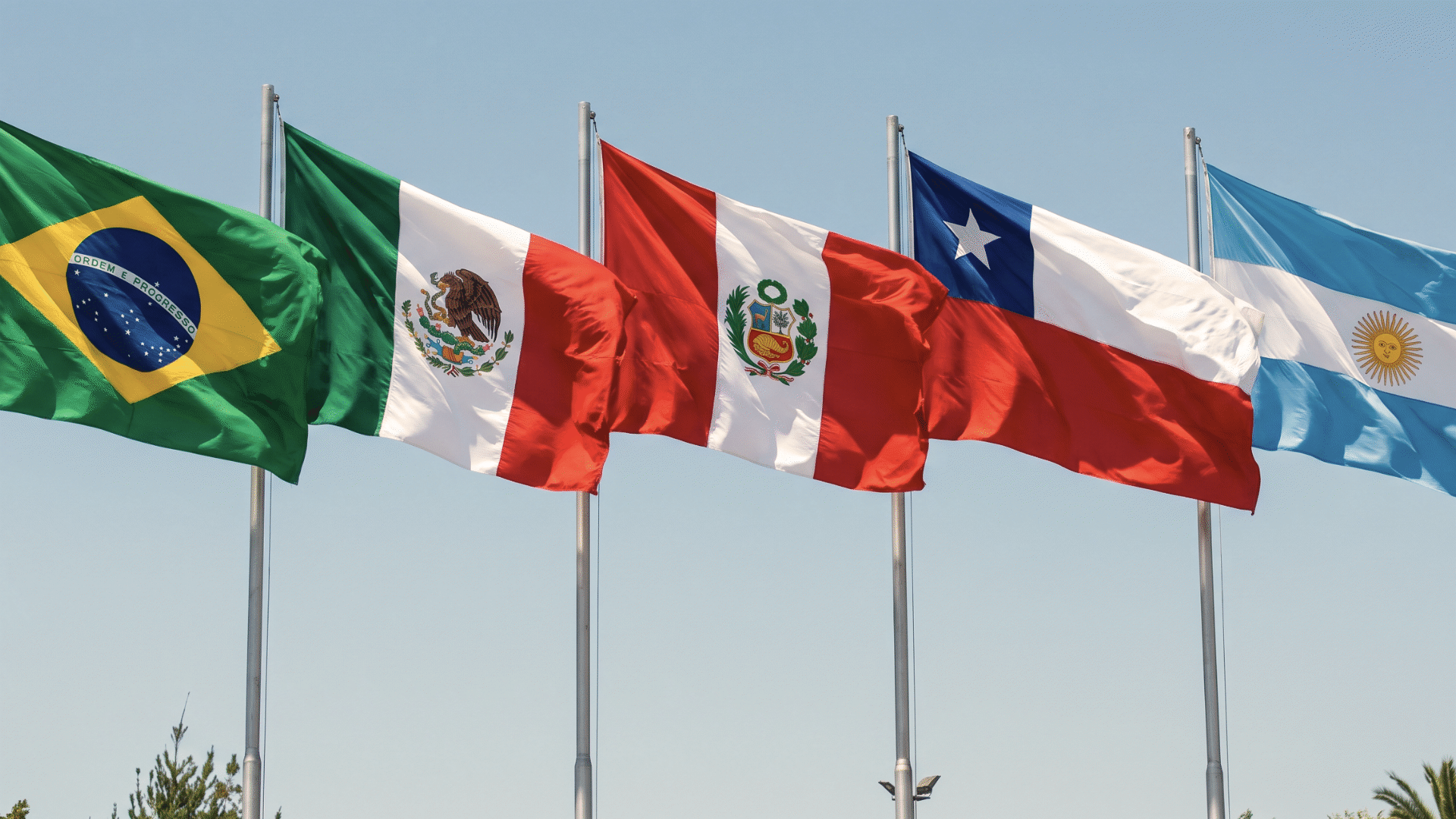
We track about 150 companies across the five markets below: Peru, Mexico, Brazil, Chile and Argentina, arranged from the most straightforward to access to the most involved. Coverage is thinner than in Asia, and many Latin American companies pay modest or irregular dividends. Mexico is the thinnest case, with only two companies in our data, so treat that section as an example rather than a portrait of the market. And as before, if a company here is new to you, our news summaries are the fastest way to get the current context around it.
A Few Terms Explained
- ADR (American Depositary Receipt): A certificate traded on a US exchange that represents shares in a foreign company, letting you invest without opening an account on that company's home exchange. Price generally tracks the home-listed shares closely, since market makers arbitrage away any gap, though liquidity can run thinner than the home market for smaller names. Dividends arrive in USD after conversion, usually with a small additional depositary fee on top of the home country's withholding tax.
- Holding company: A company whose main business is owning stakes in other companies. Its own dividend depends on what those holdings pay up to it, which is why payouts can vary widely from year to year.
- Interest on equity (JCP): A Brazilian way of paying shareholders that companies treat as an interest cost for tax purposes. Foreign investors face a higher withholding rate on it (17.5% from 2026) than on ordinary dividends (10%).
- Capital controls: Rules that limit moving money across a border or converting local currency into dollars. For example, in Argentina, they define when and at what exchange rate companies can pay dividends to foreign shareholders.
- Dividend withholding tax: A percentage a foreign government deducts from a dividend before it reaches you, automatically, at the point of payment. Tax treaties between your home country and the company's country can lower this rate, though claiming the lower rate sometimes takes paperwork filed through your broker rather than happening automatically.
Here's where each of the five currently stands:
Name | 360° View | Safety | Growth | Dividend Yield |
|---|---|---|---|---|
Large • Diversified Metals & Mining | 72 | 64 | 78 | 63 |
X-Large • Precious Metals & Minerals | 54 | 80 | 92 | 75 |
Large • Multi-line Insurance | 100 | 89 | 98 | 91 |
X-Large • Industrial Conglomerates | 95 | 80 | 63 | 99 |
Medium • Diversified Banks | 67 | 79 | 33 | 35 |


Peru
Peru's exchange is small and heavily weighted toward mining, which fits a country that is among the world's largest producers of copper, silver and gold. The simplest way in skips Lima altogether: several Peruvian companies trade in New York as ADRs, so any broker that offers US stocks will do. Peru withholds 5% on dividends paid to non-residents, for profits earned since 2017.
Compañía de Minas Buenaventura, one of the country's largest mining companies, trades in New York as BVN. Its profile is balanced, without a clear weak spot. Growth is its strongest Obermatt rank at 78, reflecting solid revenue and profit growth compared with peers. Safety, which looks at debt, liquidity and refinancing, is the softer side at 64, held back by refinancing while debt and liquidity are solid. Professional investors are well represented among its shareholders, while analysts are more reserved. The dividend follows metals-driven earnings, so it moves with metal prices.
Mexico
Mexico's exchange is shaped by large consumer, telecom and industrial groups, and it has one quirk: companies often issue several share classes, and some are reserved for Mexican investors. Foreigners usually buy the "B" series. Interactive Brokers is one of the few international brokers that offers the Mexican exchange (BMV) directly, and for Fresnillo there is a second option, since it is also listed in London. Mexico withholds 10% on dividends from profits generated since 2014, which a tax treaty can reduce, but that applies to companies incorporated in Mexico. Fresnillo is incorporated in the UK, which does not withhold tax on dividends, so the Mexican rate is not the one that matters for this company.
Fresnillo, the precious metals miner with mines across Mexico, shows how business strength and market view can diverge. Obermatt Safety (80) and Growth (92) are both strong and the Dividend Yield rank is high at 75. The 360° View of 54 is only moderate because of two weaker ranks: Value at 22 and Sentiment at only 6. Third-quarter silver and gold production fell on lower grades and throughput at several mines. Dividends in this sector follow metal prices, in both directions.
Brazil
Brazil is the largest market in Latin America, and until recently foreign retail investors had few easy ways in. That changed in December 2025, when Interactive Brokers began offering Brazil's B3 exchange to eligible clients outside Brazil. The tax picture changed this year as well. Since January 2026, Brazil withholds 10% on dividends paid to non-residents, with no minimum threshold. Many Brazilian companies pay part of their return as interest on equity instead, which is taxed at 17.5% for foreign holders. Dividends approved before the end of 2025 can keep the old exemption if they are paid on the approved terms.
Porto Seguro, a Brazilian insurer best known for car insurance, is the only one of the five with Growth, Safety, Value and Dividend Yield in the dark greens: strong fundamentals at an attractive price compared with peers. Sentiment is the exception. It is middling, with analyst opinions notably cautious, suggesting the market has not fully caught up with the business. The latest news is another interest-on-equity payment, and social media commentary describes the company as a safe place to hold through volatile markets. It has approved interest-on-equity payments every quarter this year, plus an ordinary dividend earlier on.
Chile
Chile's exchange is small and weighted toward banks, utilities, retail and resource companies. Access depends on your broker: not every international broker offers the Santiago exchange, and a Chile-focused ETF is the simpler alternative, though it will not single out one company. Chile's dividend tax is unusual. Foreign shareholders are taxed at 35%, but the corporate tax the company has already paid is credited against it, so 35% is the total burden on those profits rather than an extra layer on top. Unlike in most countries, tax treaties do not reduce this rate.
Quinenco, the holding company of Chile's Luksic family with stakes in banking, beverages and shipping, is the income story of the five. Its Obermatt Dividend Yield rank, which compares the dividend with that of peers, is the highest of the group at 99, and Safety, Sentiment and analyst opinions are all strong. Growth is the softer side at 63, with leverage being the one weak point on the balance sheet, though refinancing and liquidity are in good order. As a holding company, it depends on what its stakes pay up to it, so the dividend varies from year to year.
Argentina
Argentina is the most involved market on this list. Its own exchange is hard to reach for a European, but the larger companies trade in New York as ADRs, so an account for US stocks is enough. The harder part is the money. Argentina has long restricted converting pesos into dollars and sending money abroad, and dividends have been caught up in those capital controls. According to a 2026 legal guide, companies can now pay dividends from profits of the 2025 financial year onward at the official exchange rate, while older profits remain restricted. Dividends paid to foreign shareholders face a 7% withholding tax.
Grupo Financiero Galicia, one of Argentina's largest private banks, is known for its century-long tradition combined with innovation that drove its digital wallet platform Naranja X to become one of Argentina's biggest. The bank also supports fintech startups across South America. Obermatt Safety Rank and Value Rank are solid at 79 and 70 respectively, but Growth (33) is weak, held back by capital growth even though revenue growth ranks at the very top. The Dividend Yield rank is low, which makes it the modest-dividend case: a bank chosen for its balance sheet and valuation rather than for its payout, although it did approve a dividend again this April.
From Peru's ordinary US stock account to Argentina's capital controls, these five markets show that "investing abroad" in Latin America can mean very different things from one country to the next, and that a company does not need a high yield to belong on a watchlist. A strong balance sheet or fast growth can be enough, as long as the dividend that exists is real. The next part of this series moves on to another corner of the world.