If you rely on the Swiss Market Index (SMI) or the Swiss Performance Index (SPI) as the "conservative" core of your portfolio, you may be unknowingly accepting a significant concentration risk. While often marketed as a diversified safe haven, the SMI is currently a "Heavy Crown"—a top-heavy structure where just four entities (Nestlé, Novartis, Roche, and UBS) dictate your financial outcome. To counter this, the Obermatt Swiss Pearls Index (OMSP1) offers a systematic alternative that prioritizes the overall 360° View performance over market capitalization for the 36 stocks in its index.
The Institutional Distortion: Why Size ≠ Value
There is a mechanical reason these big four stocks dominate your index exposure: Institutional Inevitability. Because global ETFs and pension funds are mandated to track the SMI, they are forced to buy these stocks regardless of their fundamental health or current valuation. This creates a self-reinforcing loop where the stock price is driven by index-tracking flows rather than operational excellence.
History warns us about the risks of over-reliance on index giants. Consider the "Nifty Fifty" of the 1970s or the more recent fall of previously "untouchable" institutions like Credit Suisse. When you buy the SMI today, you aren't just buying Swiss quality; you are buying into one of the most crowded trades in the European market.
When you look at the data, the big four of the SMI starts to show its weight:
- Nestlé: With a market cap nearing CHF 280B, achieving double-digit growth is an immense challenge. Investors pay a high Price-to-Earnings (P/E) premium for a company that acts as a proxy for global inflation. In our system, Nestlé’s Value Rank frequently lags because investors are paying a "scarcity premium" just for the privilege of owning a blue chip.
- The Healthcare Giants (Roche & Novartis): These companies currently define the SMI's performance, but they face constant pressure from "patent cliffs" and massive R&D cycles. Buying the index means buying them at their peak valuations (CHF 311B and CHF 303B respectively).
- UBS: Post-merger, UBS has become a dominant force (CHF 153B cap), but its Sentiment Rank is highly susceptible to global banking volatility. Direct exposure to these macro-financial shifts may not align with a disciplined, fact-based strategy.
We believe investors should own a company because it’s better, not simply because it’s large. The Obermatt Swiss Pearls Index (OMSP1) ignores market capitalization and focuses exclusively on performance-driven Obermatt Ranks.
By moving beyond the Big Four and into the industrial and specialized technology leaders, the true engines of Swiss innovation, we identify stocks that are not yet "over-owned" by global funds. This decouples wealth from the fate of a few mega-caps and spreads risk across the broader Swiss economy.
Performance over Popularity
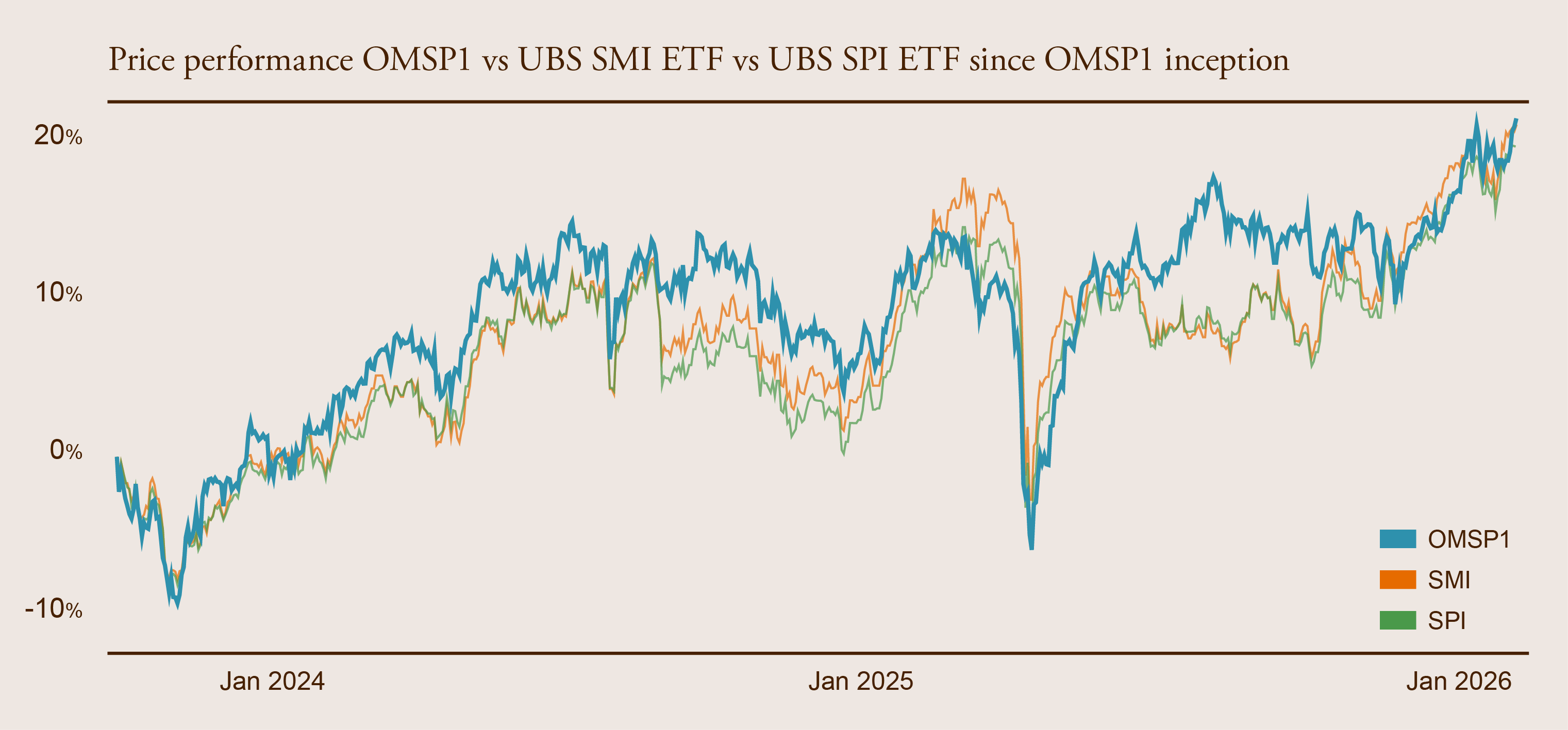
To understand why a performance-weighted strategy is superior to a capitalization-weighted index, we must look at the historical data. The following charts show that by focusing on the 360° View, the Obermatt Swiss Pearls Index (OMSP1) consistently outpaces the SMI and SPI for the vast majority of the period since its inception, by identifying high-quality mid-caps that the large-cap indices often overlook.
Quantifying Risk and Reward: The Strategy Scorecard
The outperformance of OMSP1 is of high quality and delivers more yield per unit of risk than the benchmarks.
| Metric (since inception) | OMSP1 | SMI | SPI |
|---|---|---|---|
| Sharpe Ratio | 0.63 | 0.62 | 0.61 |
| Sortino Ratio | 0.88 | 0.84 | 0.80 |
| OMSP1 Beta vs | 0.64 | 0.70 | |
| OMSP1 Jensen Alpha vs | +2.46% | +2.80% | |
The OMSP1 converts risk into return more efficiently than the SMI and SPI: The higher Sharpe and Sortino ratios prove better performance for both total and downside risk. The beta deviating from the market and the Jensen Alpha of 2.46% / 2.80% excess return show that the OMSP1 creates additional value with lower risk.
Volatility in Context: Rolling 12-Month Performance
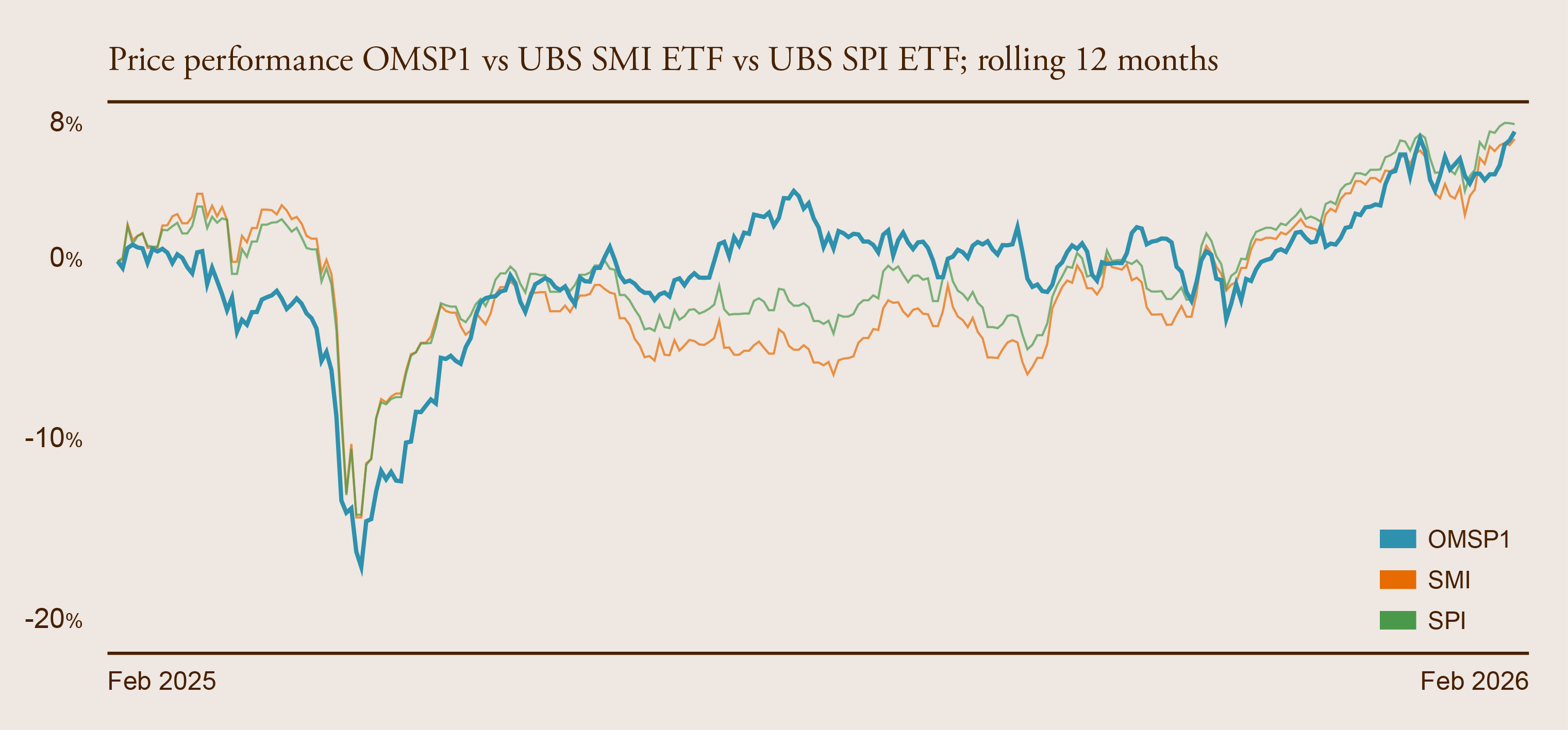
Short-term volatility is often the price an investor pays for long-term outperformance. In 2025, while the SMI and SPI struggled with increased concentration risks and volatility, OMSP1 demonstrated superior recovery and growth trajectories.
Passive indexing in the Swiss market currently equates to an unintended concentration in just four global giants. For the investor seeking alpha in 2026, the opportunity lies in the "Swiss Pearls"—those mid-cap leaders currently trading at a significant discount to their large-cap peers. Shifting your strategy from a market-weighted approach to a performance-weighted one allows you to capitalize on Swiss innovation at fair valuations.

Invest in a professionally managed index of 36 stocks selected each month using the Obermatt method. Available for retail investors on the SIX Swiss Exchange (Ticker: OMSP1). Learn more